Over a year ago I came across a trailer online for a documentary entitled “The First Padres.” The trailer instantly caused me great excitement as it touched upon two of my favorite parts of the game: the old Pacific Coast League & Baseball in the city of San Diego. I had to know more about the film so I quickly reached out to filmmaker Chris Boyd and struck up an ongoing correspondence regarding the film which still lasts to this day.
Boyd recently took some time out of his schedule to do a ten question Q&A with me regarding the film and I think it came out pretty well, as it’s quite informative. If you love the game of Baseball and it’s incredible history, please read the interview and check out the film. Even if you are not familiar with the old Pacific Coast League and have no interest in the Padres, I guarantee that it’s a film that will be enjoyed by all Baseball fans
The film recently aired for the first time on KPBS in San Diego and was viewed at the 2012 Baseball Hall of Fame Film Festival in Cooperstown, New York. There will be additional airings of the film via PBS in the coming months in addition to the DVD being released, which went on sale today online. You can purchase the film HERE and I strongly suggest doing so!
So so without further ado, here is my interview with Chris Boyd of The First Padres:
1) I assume you love the game of Baseball. If this assumption is correct, can you tell me about your personal history and early memories of the game and what Baseball means to you?
-In terms of personal baseball memories, I’m a kid of the Tony Gwynn and Ken Caminiti era, so my earliest memories are at Jack Murphy Stadium watching the Padres. I didn’t play anything past Little League so I’ve enjoyed the game as a spectator for a long time. But I’ve had great times with my brothers at Padres games, and when I had to live in Los Angeles I had plenty of great nights watching when the Padres were visiting. Baseball is a great game and I think it means a lot of things to so many people, which makes it the perfect subject for films of all kinds, and stories of all kinds.
2) What was your knowledge of the old Padres of the Pacific Coast League prior researching for the film?
-I didn’t know anything about the league at all. I knew the PCL still exists as a minor league but I had no idea about the history. Everything I learned about the team was new to me, even though I’ve lived in San Diego my whole life. That was one of the big motivations for doing the film, to introduce people to all of this history.
3) I assume you grew up a fan of San Diego Padres due to being from San Diego? Tell me about your feelings about the organization and if they have been supportive of your film and if so, in what ways?
-The Padres have been very helpful to me. I worked with them last year during the 75th anniversary of the PCL, sharing some of my footage with them for their PCL Salute Day. And people in their media department were very helpful to me, sharing some of the footage that has been out there in various forms over the decades. I have always loved the Padres, and I know that the ownership situation has been a little bit in flux over the last few years, but the Padres in one form or another have been our team for the better part of a century so I look forward to cheering them on for many years to come.
4) Regarding interviews with ex-players and their families, are there any enjoyable experiences that you would like to share which did not necessarily get caught or translate to film?
-All of the players I had the chance to interview were just surprisingly open and humble men. For guys who got to live a dream — playing baseball professionally — they all were very grounded and happy to talk about their experiences. I hope that does come across in their interviews, but at the same time you can’t see on film just how welcoming they were leading up to the interviews. I would call them and talk to them and they couldn’t have been nicer about welcoming me into their homes and giving me their time.
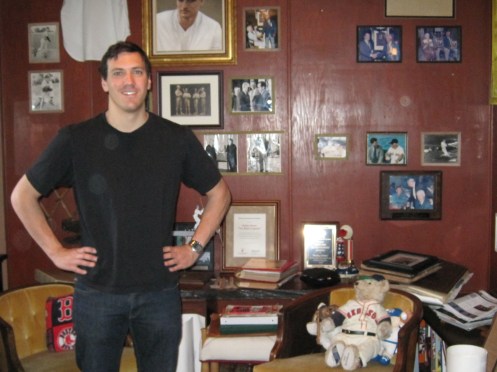
5) Regarding Hall of Famer Bobby Doerr, tell us about your experience going to visit him in Oregon (photo at top of the page is from Doerr’s home). Was it difficult for him remember his one season (1936) in San Diego?
-Bobby Doerr’s memory is so sharp, it’s unbelievable. He spoke about individual at-bats and individual batting cage sessions like they happened yesterday rather than 75 years ago. He was the most down-to-earth man, with a beautiful home in rural Oregon filled with incredible baseball memorabilia in his memorabilia room. But to be his age, to have the memory he does and the stories and to be able to live on his own in a place he loves, it was pretty incredible to see. That was the one road trip I made while working on the film, and it was a really great few days with my director of photography and researcher that made the film take on a whole new dimension.
6) Regarding Ted Williams, were you aware that he started his professional career with the Padres prior to starting work on the film? Did you learn anything about Williams related to his time with the Padres that you found interesting?
-I wasn’t too familiar with Williams’ career here beyond the fact that he was from here. Growing up in San Diego you know that Ted Williams was a native son, but I think his actual Padres career doesn’t get the full exposure it could — I hope that the film will help to change that, because it presents a substantial section on Ted Williams and, unlike other work done on him, deals exclusively with his Padres career.
7) Tell us about Baseball Historian Bill Swank and how he contributed to the film. I assume the film would have much more difficult to complete without his assistance?
-Bill Swank made the film possible. He is the expert on the subject, the only expert, and without him I couldn’t have hoped to make the film legitimate in any way. His books were my main research sources, and furthermore his personal help is what gave me access to interviewing players. He put in the effort years ago to track down all of the former PCL Padres, and it’s all of his work that really made my film possible. Bill loves the subject, loves baseball in general, and had been waiting to see a full-length film made about this subject for a long time.
8) What was the hardest part of the film? Were there ever any times that you became completely frustrated or ran into walls? Was there anything (or anyone) you wanted to include in the film but were not able to do so for any particular reason?
-The hardest part of the film was just doing it on my own. From the writing, producing, directing, and editing to all of the small details like photo retouching and digging out pictures from microfiche — I had zero company backing, no financial support, and only the kind assistance of some video professionals who let me use their cameras and equipment.
So when it came time to edit, and go through all of the technical processes that go into making a full movie for television, that was always a one-man operation right up until the end. I had a color correctionist and a composer, but those were the only people involved in post-production and that was really a challenge. I basically edited the movie for a year, and sometimes would just cut for a few minutes a night after working a day job all day. I never knew if it would be on television, but I just kept the faith that something would come out of it if I kept working at it.
9) How has the response to the film been so far? Have there been any particular reviews or responses that have touched you or caused incredible gratification for doing the film? I must admit that from where I stand, I have only seen extremely positive reviews and a hunger to view it again and own it when it is released on DVD.
-Through the website, I’ve received a lot of e-mails from people and all of them have been really positive. Some of the best have come from family members of players or team personnel, telling me some of their personal stories and saying how nice it was to relive some of the history of the team that they remember from when they were younger. So those have probably been some of the most rewarding responses. Also, re-reading some of the posts on Twitter that were being put up live while the film aired on KPBS was pretty cool.
10) What’s next for the film? Any word on future airings in or outside San Diego? Any last words that you would like to get out to the readers of 90 Feet of Perfection?
-I’m trying to get the film out there as much as possible. DVD’s will be available, and I’m looking into an online streaming platform. The film featured at the Baseball Hall of Fame Film Festival in September and if there are other festivals it is eligible for I will definitely enter. But I hope that the film can live on for awhile for San Diegans and become a part of the city’s history.
Posted in Baseball
Tags: artie wilson, baseball, Bill Lane, Bill Swank, Bobby Doerr, Cedric Durst, Chris Boyd, Ed Erautt, frank shellenback, George McDonald, Harry "Suitcase" Simpson, Jack Graham, Jack Murphy Stadium, Jimmie Reese, John Ritchey, ken caminiti, Lane Field, lefty o'doul, Luke Easter, Major League Baseball, Max West, minnie minoso, MLB, National Baseball Hall of Fame, Negro League Baseball, pacific coast league, PCL, Pepper Martin, Qualcomm Stadium, Ray Brown, Rick Crawford, Rod Graber, Rudy Regalado, san diego padres, San Diego Stadium, Steve Mesner, ted williams, tony gwynn, vince dimaggio, Westgate Park






 ninety feet of perfection.